Your Guide to Font Licensing as a Small Business
What is licensing, how to license your fonts, and other commonly asked questions answered by a brand designer.
You’ve just received your brand identity files. Your designer handed you a gorgeous typeface palette with two stunning paid fonts included, and instructions on where to buy licenses. Even if your designer informed you of this cost up front, you may still be thinking, “Wait, why do I need to purchase a font? And which licenses do I really need to pay for?”
Truth be told, font licensing confuses most people. There's no single answer to what you can and can't do with a font file, because it depends on the specific license agreement between you and the foundry that created it.
Here's what you actually need to know.
What Is Font Licensing?
Fonts are considered intellectual property, just like photography or music. A font license is a legal agreement that gives you permission to use a specific typeface in certain ways, whether that's in print, on a website, or in an app. Not all fonts are free to use, even if they came with your software or were sent to you by someone you work with.
The foundry (the company or designer who created the font) owns it. When you buy a license, you're paying for permission to use their work under specific conditions.
Common Types of Licenses (And What They Cover)
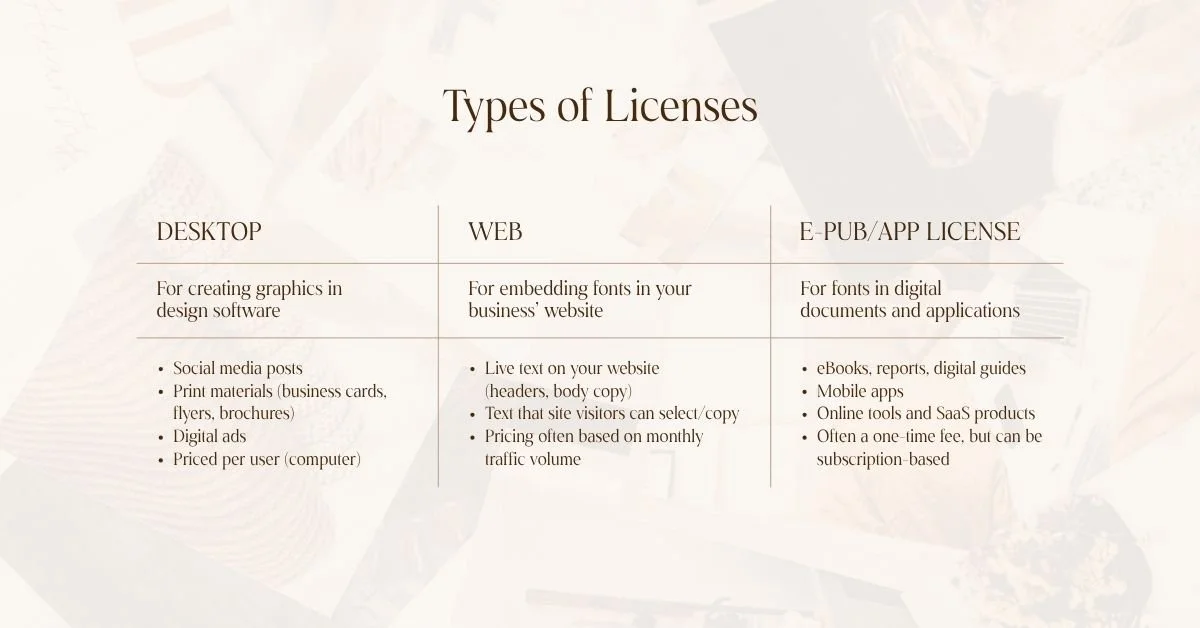
Depending on how you'll use the fonts in your brand, you may need one or more of these licenses:
Desktop License For designing print and digital graphics in Adobe, Canva, or similar tools, and permission to store it on your computer. This is the most common license, and the bare minimum for most businesses. One-time fee per user.* Cost range: $15–$100+
Web License For embedding the font on your website so it displays properly for all your visitors. The foundry is essentially saying "yes, you can serve this font file from your domain." Depending on foundry, this can be a one-time fee or an annual subscription. Cost range: $30–$500+ (typically based on monthly traffic)
E-Pub/App License For fonts embedded in digital publications like ebooks, lead magnets, guides, or mobile apps. Cost varies by distribution scope. This license is often the most expensive.
You only need to license fonts for the specific ways you plan to use them. If you're only using a font on your website, you don't need a desktop license.
*A user is defined as one computer system or laptop. So, as a small business, you would technically need to purchase a desktop license for every computer that it’ll be used on. You cannot just purchase one license, and then share the files to all your employees. (Ex. You have a team of three people and you all share responsibility for making social graphics, print flyers, etc. You would need to buy three separate desktop licenses to use the font legally). Web licenses and e-pub/app licenses do not require a license per user.
Commercial vs Personal Use
Many free fonts are only licensed for personal/hobby use. If you find a free font you love, always check the license terms before using it in your business. Using a personal-use-only font for your business logo, website, or marketing materials violates the license, even if the font is free.
What Do You Actually Need to License?
Here's the part that usually surprises people:
If your logo uses a paid or licensed font, you don't need to buy a license for it. When you work with a designer, they should provide you with final files where the font is outlined or flattened—meaning the typeface is converted into shapes, and cannot be used to type new letters or words. You can use those files anywhere without owning a license, because the font itself isn't embedded in the file, and your designer is operating within their own license when creating the logo.
The only fonts you may need to purchase a license to use are the ones in your brand typeface palette. These are the fonts you'll use across your website, social media graphics, marketing materials, and other content you create yourself. If you're planning to build out a lot of branded content, the fonts in your palette need to have licenses that cover those use cases.
So if your brand identity includes:
A display font for headlines
A body font for longer text
And you only plan on using your brand on print materials like brochures, business cards, and maybe digital content on social media, you’ll need a desktop license at minimum. If you need to upload your own font file to a website, you’ll need to pay for a separate web license. If you have an app you want the font incorporated into, you’ll need to pay for an app license.
Should You Invest in a Paid Font?
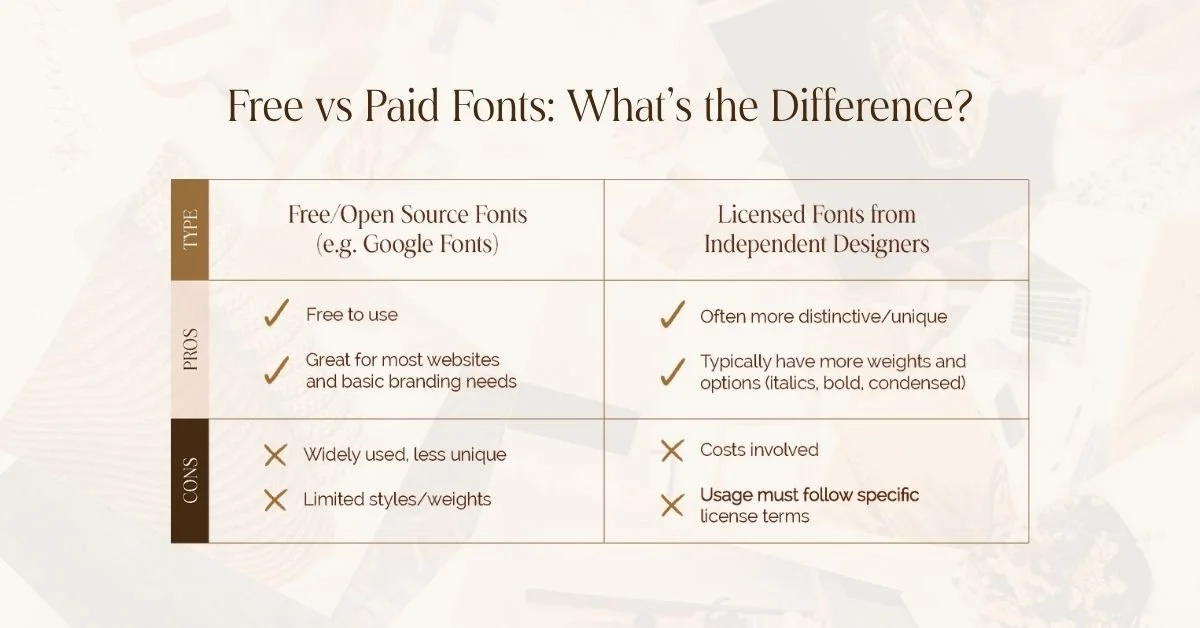
When free fonts are enough: You can absolutely build a strong brand with a tight typeface palette using only free fonts. Google Fonts are basic, but they have enough weights and options to create visual hierarchy, and they work across almost every platform: Google Docs, Squarespace, Adobe, email, you name it. The consistency of having your fonts available everywhere matters more than chasing a trendy typeface that only works in one place.
When paid fonts make sense: Invest in a paid font if you want something more unique, more stylized, or with custom details like special ligatures and flourishes that free fonts typically don't include. Distinctive typography can elevate your brand and help you stand out in a crowded market.
The Canva trap: Here's something I see all the time: people fall in love with a beautiful, stylized font they discover in Canva, not realizing it requires a paid license elsewhere. Just because you have access to a font in Canva doesn't mean you'll find it in Google Docs, Squarespace, your email, or Adobe. It's locked to that platform. Google Fonts, on the other hand, are incorporated into most design tools and platforms, so if consistency across your digital tools matters to you, that's worth considering.
The real question: Before investing in a paid font, ask yourself: where will I actually use this? If it's only in Canva, that works. If you want to use it across your website, email, documents, and social graphics, you either need a font that's available everywhere (like Google Fonts) or you need to purchase the licenses that cover all those uses.
What Do Paid Font Licenses Actually Cost?
Font pricing varies by foundry and usage, but here's a general range:
Desktop License: $15–$100+ (one-time fee per user)
Web License: $30–$500+ (depends on your traffic volume)
E-Pub/App License: Prices vary based on distribution scope
Some fonts use a one-time fee model. Others work on subscription or tiered pricing based on how much you use them. Always check the specific foundry's pricing structure before committing.
Most of the brands I’ve built for small businesses, my clients ended up spending less than $100 on all the font licenses they need. I always work within your budget before introducing fonts—I’d hate for you to fall in love with something and realize later it’s going to cost more than you’re willing to spend!
What You Can Expect From Me
If you're working with me on a brand identity project, here's how I handle fonts:
I'll never include a font that requires a paid license without discussing it with you first. We'll talk about whether the investment makes sense for your brand and your budget up front, and I won’t include a font in your brand concept presentation unless I know all required licenses are within your budget.
If we go with a paid font, I'll send you direct links so you can purchase the correct license securely. I'll make sure to recommend the right type of license(s) for your specific needs, as well as safe places to buy them so you don’t get scammed or hacked.
I always provide recommendations of free font alternative, even if you end up purchasing fonts. Sometimes platforms (like Google Docs) do not offer an option to upload your own font files, and you’ll need an alternate that’s still on-brand.
I’m available to answer any questions that come up with purchasing licenses, downloading and uploading fonts, etc. I also include tutorials on how to upload and find fonts to popular places like Canva and Google Docs in your Debut Kit, so you’re not stuck with files you don’t know how to use.
And when we finish your brand identity project, any logo files you receive will have fonts outlined so you can use your logo anywhere without needing additional licenses.
Frequently Asked Questions
What if I use a paid font without buying a license?
Technically, you'd be violating the font's license agreement, which is a copyright violation. In practice, most foundries don't pursue individual users. But you could expose your business to legal liability, especially if you're using the font commercially. It's just not worth the risk. The licenses are reasonably priced for the value you're getting, and it's the right thing to do.
Can I use Google Fonts on my website without any license at all?
Yes. Google Fonts are free and open-source under the SIL Open Font License (OFL). You can use them on your website, in print, in apps, everywhere. There's no license to buy. The trade-off is that every other brand out there has access to the same fonts, so they're less distinctive.
Why do I need both a desktop and web license if I already have the font file? Can't I just use the file I have?
Having the font file and having permission to use it are two different things. The license agreement specifies how you're allowed to use that font, and different use cases require different licenses. A desktop license typically prohibits embedding the font file on a website (that would violate the terms). A web license specifically permits it. You can't just upload your desktop font file to your website; that breaks the desktop license agreement. Think of it this way: you might own a song, but you need different permission to play it in a coffee shop versus broadcast it on the radio. Same file, different use cases, different licenses.
If I buy a web license, can I use the font in my social media graphics too?
Not automatically. A web license typically covers embedding the font on your website specifically. Social media graphics are technically a different use case. Some foundries consider it covered, others don't and require you to purchase a desktop license. Always check the specific license terms or ask the foundry directly. Some designers use desktop licenses for social graphics and a separate web license for the website to be safe.
Is it worth paying for fonts when there are free options available?
It depends on your brand and your goals. If you want your brand to feel memorable and distinctive, then yes, the variety and quality of paid fonts usually makes the investment worthwhile. If you're bootstrapping and need to keep costs down, free fonts can work well. There's no one right answer. It's about what matters most to your business.
What if someone on my team sent me a font file they bought? Can I use that?
Font licensing relies heavily on integrity. Even if you have a font file in your possession, you still need to have your own license to use it properly. Licenses are most commonly issued to individuals*, so even if your co-worker has permission to use it, that does not transfer to you automatically. Desktop licenses specifically require a new license for each user (computer), so companies will need to factor in the cost of how many employees will be using the fonts when evaluating budgets for licensing.
*There are some cases where a company may purchase a commercial/large organization desktop license from a foundry to cover all usage. These licenses are often very expensive, due to the high usage of the font.
Can I use a free font I found online for my business?
Not always. Many free fonts are only licensed for personal use. Before using any free font in your business, check its license to confirm it allows commercial use. Google Fonts are safe, as they're all licensed for commercial use. For others, look for language like "free for commercial use" or check the foundry's terms. Using a personal-use-only font in your business violates the license.
Aliya Mooney is a brand identity designer and strategist based in Boise, Idaho, and the founder of Hearthstone Creative. With a B.A. in Advertising and a background in in-house design, boutique agency work, and brand strategy, she works with established small business owners and values-driven founders to build brand identities that are strategic, intentional, and built to last. Learn more about Aliya here.