Does My Start-Up Need Branding Right Away?
I might be the first brand designer to admit this to you: small businesses don’t always need professional branding.
Wait, what?
Brand design is a tool that most businesses eventually need, but not necessarily right at the beginning. And I can’t in good conscience recommend that every new start-up invests in a brand package unless they actually need it.
Here’s a list of things to consider when evaluating if you need to book a brand designer from the beginning, or if DIY will do for a while.
Level of visibility
Packaging/Signage
Trademarking/Legal Protection
Level of Visibility
Consider every place your brand is going to be displayed once.
Every brand should exist on these items at minimum:
Social media content
Social media profile assets (profile pictures, banners, highlight covers)
Website or landing page
Email signature
Google business page
Business cards
Contracts/Invoices/Proposals
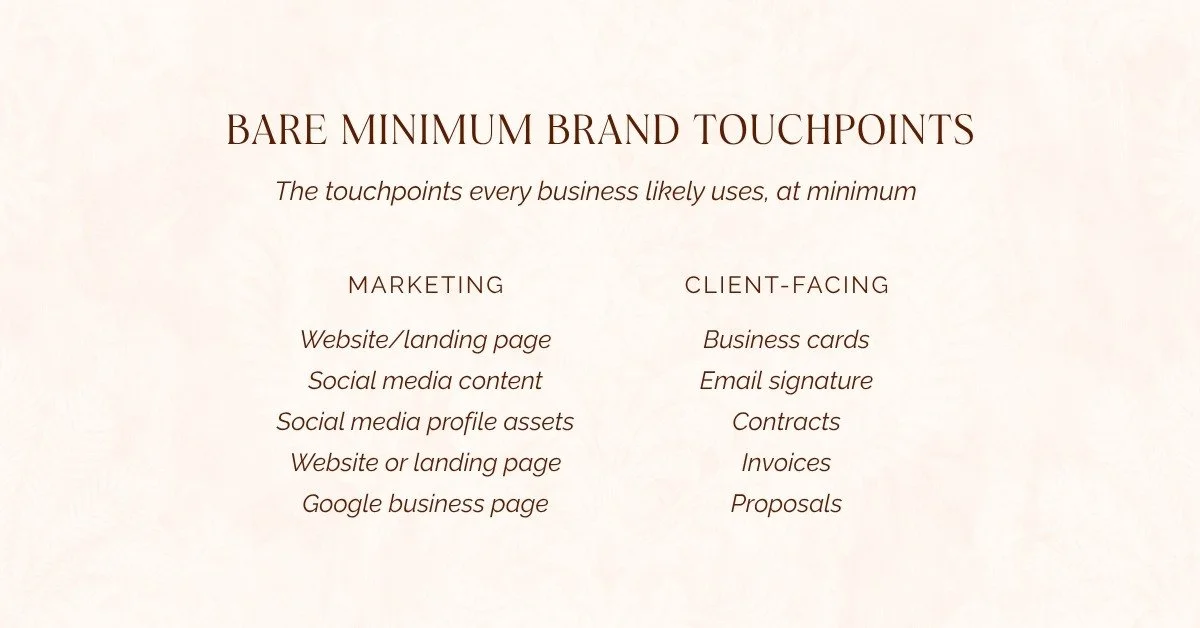
These places are the bare minimum for most businesses. There are likely many more applications your brand will appear on.
If your level of visibility is limited to the basic items on this list, you probably can use DIY branding to start out.
While eventually you may have to update everything when you rebrand, it likely would take less than 10–20 hours, with re-printing costs staying fairly low.
If you have your branding in more places than the list above, consider the cost of:
Reprinting every item after a rebrand
The time it’d take to update all materials yourself or
The time it’d take to find a designer and the investment of paying them to update materials for you
Packaging + Signage
Businesses that have custom packaging and businesses that have physical brick-and-mortar locations typically have a higher overhead cost.
If you are a product-based business, chances are you’ll need your branding applied to packaging: on cans, wrappers, bags, boxes, tissue paper, etc.
For you, a brand project investment not only considers the cost of the branding project itself, but the cost it takes to replace all your packaging once it’s updated.
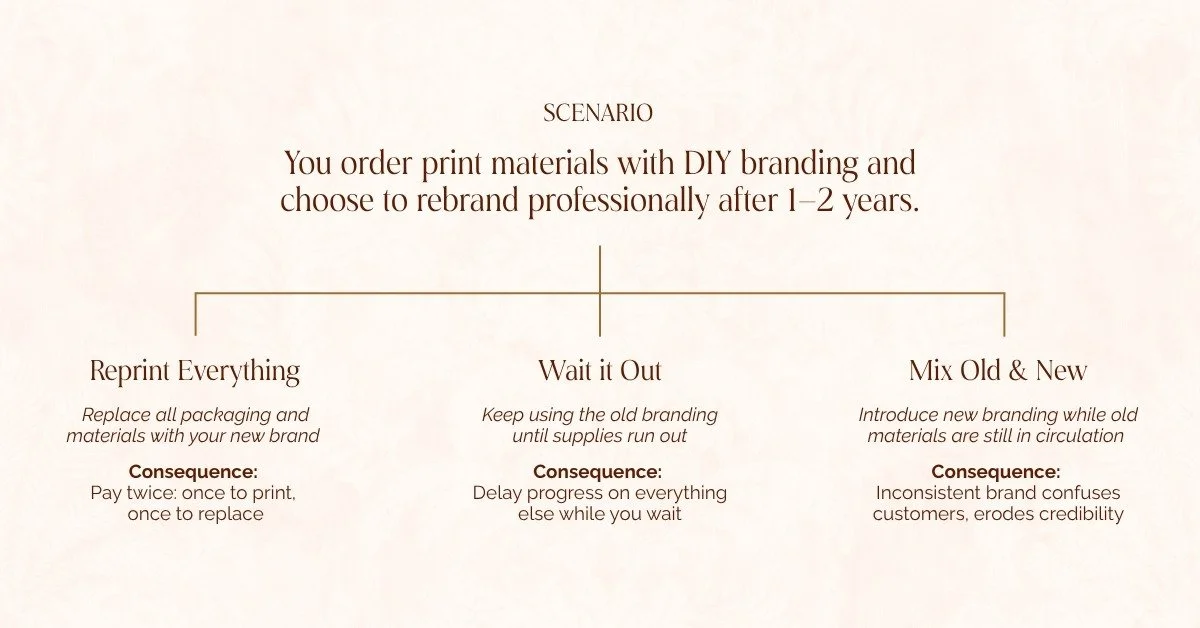
The up-front cost of printing custom packaging will be high. If you start with a DIY brand you outgrow within a year, you’ll need to pay to completely reprint all your packaging with updated branding.
OR you’ll feel the need to stick out your DIY branding until you use up old product/packaging, which means delaying progress for other parts of your business.
OR you’ll mix old branding with new branding, which could confuse your customer, and disrupt your brand recognition and credibility.
Aside from satisfying the need to stand out on the shelf from competitors, and look polished and trustworthy to consumers and investors, a professional brand saves money and wasted product/packaging later down the line.
In a similar vein, brands that have physical locations with mounted wall-signs, exterior marquees, folding signs on sidewalks, internal signage (like menus), etc. should also consider investing in professional branding up front.
The cost of commissioning signage, packaging, and other large batches of printed materials, and then having to replace it later on is expensive and quite the headache. If this matches your business model, consider booking a brand designer before paying thousands on print materials.
Businesses who work remotely, don’t have a brick-and-mortar location, and don’t have high amounts of print materials can likely use DIY branding to start out without much worry.
Trademarking + Legal Protection
After you’ve been in business a while, you’ll want to be sure you can protect what’s yours.
Most business owners and trademark lawyers recommend that a business’ logo is trademarked if you:
Have built a substantial brand following
Are in a highly-saturated industry
Have a brand name you want to protect from unauthorized third-party use
Here’s where DIY branding really starts to fall short.
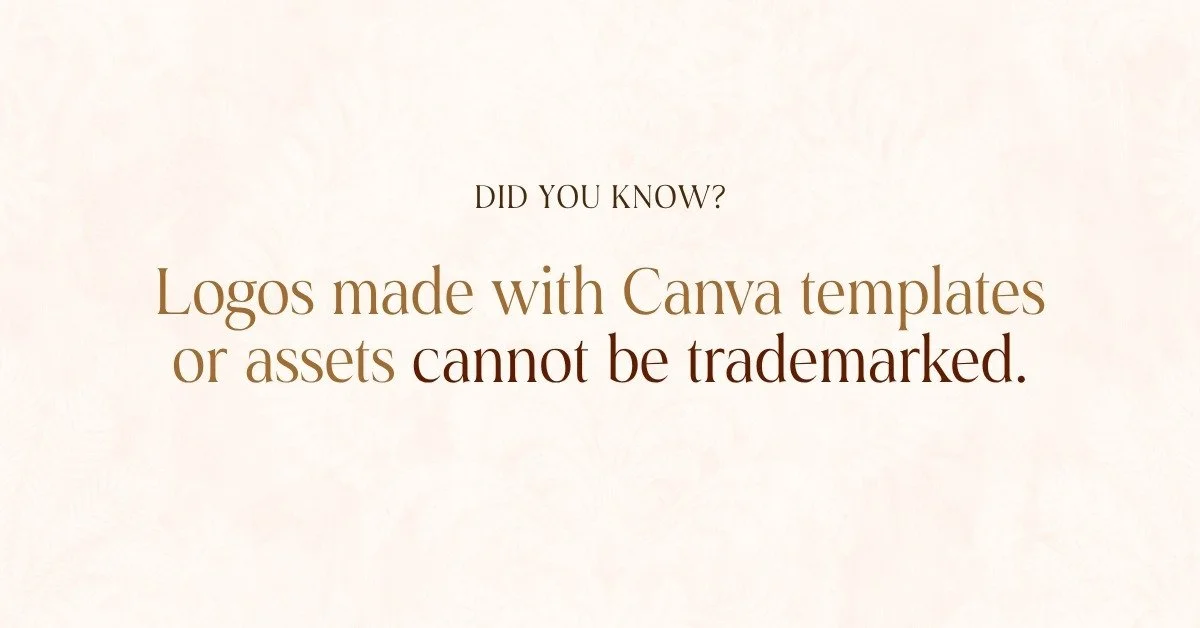
Canva logos built with templates are under a non-exclusive license. Meaning, you cannot trademark it, even if the name is yours, and the fonts/colors have changed.
Canva’s guidelines are very clear on this: unless you built the logo from scratch in Canva, or uploaded a logo designed by you or commissioned from a designer elsewhere, you cannot trademark Canva logos.
AI logos are a bit of a gray area as modern legislation struggles to keep up. According to Bloomberg Law, logos generated by AI may be trademarked, but they often will not be protected by copyright—which means anyone could hypothetically use your logo in a non-branding or artistic use-case and not be liable.
In general, if you’re wanting to legally protect your brand, working with a human designer will be the safest and most straight-forward path to take. At least until more legislation is introduced on the topic of generative AI.
If you are in the following categories, starting out with DIY branding is probably okay until you find yourself running into its limitations:
Your business exists mostly online
Your business is a side-gig and/or you’re not planning to invest a lot of money in it until it’s proven to be working
You aren’t sure of the name, what you’re selling, who you’re selling to OR you think it could change in a year or so
If you are a new business and fall under the below categories, it’s highly recommended you start with a professionally-designed brand identity:
You have a wide variety of applications you’ll apply your branding to (past basic things like social media, a website, and legal documents)
You are planning to use your brand on several print materials (packaging, signage, etc.)
You want to legally protect your logo/brand from founding onward
The businesses that get the most out of a brand investment are the ones who come to it ready — not the ones who came earliest.
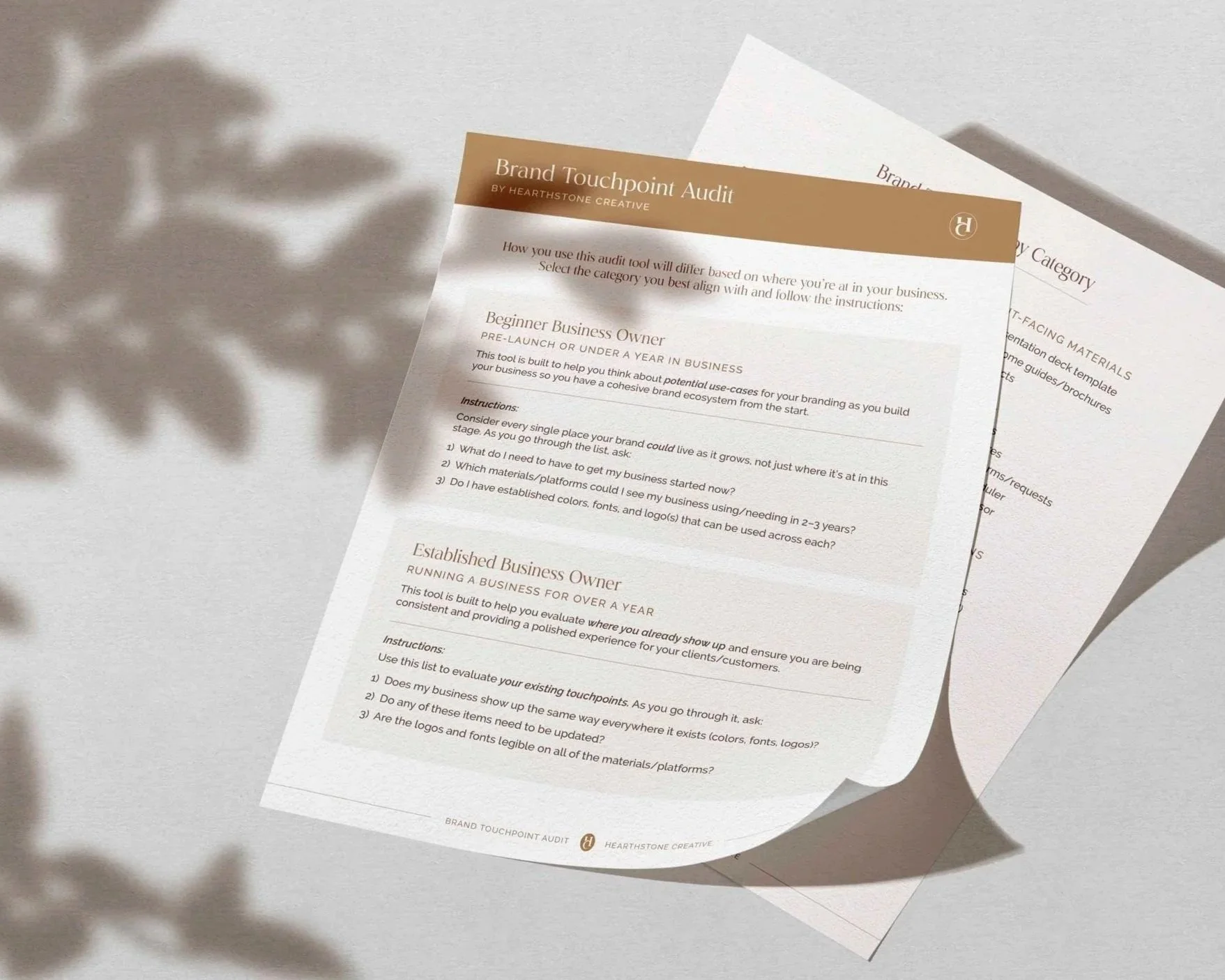
Want a complete picture of every place your brand shows up?
Download the free Brand Touchpoint Audit
A useful reference for evaluating whether DIYing is the right move for now or if it’s time to invest in a professional brand.
Frequently Asked Questions
When should a small business invest in professional branding?
The right time to invest in professional branding is when the cost of not doing it starts to outweigh the cost of doing it. That typically looks like: your business is established enough that you're confident in your direction, you're applying your brand to a significant number of materials or platforms, you're in a competitive market where looking polished matters, or you want to legally protect your logo through trademarking.
Can I trademark a logo I made in Canva?
Not if it's built on a Canva template. Canva's guidelines are clear that template-based logos are under a non-exclusive license, which means the same elements can be used by anyone else, making trademark protection unavailable. If you want to trademark your logo, it needs to be a custom design created by you or commissioned from a designer outside of template-based tools.
Is DIY branding ever the right choice?
Yes. If your business is early-stage, you're still figuring out your niche, or your brand only needs to live in a handful of basic places (social media, a simple website, a business card), DIY branding can be a perfectly reasonable starting point. The time to reconsider is when you're running into real limitations: inconsistency, lack of flexibility, or a brand that no longer reflects where your business has grown or who you’re serving.
How much does rebranding cost if I start with a DIY logo?
The cost of rebranding depends on how far your brand has spread. If it's only on a few basic digital platforms, the time investment to update everything is usually manageable. Where it gets expensive is product packaging, physical signage, and large batches of printed materials (all of which you'd need to reprint or replace). For product-based businesses and brick-and-mortars especially, investing in professional branding upfront is almost always cheaper than the cost of replacing materials later. Request a free Brand Touchpoint Audit above to evaluate how many places your brand may show up.
What's the difference between a logo and a brand?
A logo is a single visual mark that identifies your business. A brand is the full experience someone has when they interact with your business—everything from your visual identity (logo, colors, fonts) to your tone of voice, how your website feels, and what people say about you after working with you. Your logo is one piece of your brand, but it's not the whole picture.
Aliya Mooney is a brand identity designer and strategist based in Boise, Idaho, and the founder of Hearthstone Creative. With a B.A. in Advertising and a background in in-house design, boutique agency work, and brand strategy, she works with established small business owners and values-driven founders to build brand identities that are strategic, intentional, and built to last. Learn more about Aliya here.