How to Find Your Zone of Genius (And Actually Use It)
If you've ever tried to answer the question "what makes you different from your competitors?" and come up completely blank, you're not alone.
It's one of the first things I work through with branding clients, and honestly, one of the hardest. In saturated industries especially, it can feel impossible to pin down an answer that's both accurate and authentic. Most people end up with something vague and forgettable, or worse, something that sounds exactly like everyone else in their space.
The problem isn't that you don't have a distinction. You probably just don’t know how to find it.
Why Generic USPs Don't Work
Most service providers build their positioning around what they do: their services, their deliverables, their process. And while those things matter, they're also the easiest things to copy.
Your real competitive edge isn't what you do. It's the specific combination of who you are, your past personal and professional experiences, what you care about, and how you think. That intersection is something no one else can replicate, because no one else is you.
That's the idea behind finding your Zone of Genius.
What Is a Zone of Genius?
As a brand strategist, one of the first things I work through with clients is what actually makes them distinct. Not just what they do, but who they are.
This four-quadrant exercise is one of my favorite tools for getting there. Instead of asking "what do you do?" it asks: who are you, really?
The Four-Quadrant Exercise
Grab a notebook and draw four quadrants. Label them:
Experience
Everything you've lived and done, professionally and personally. Don't overlook the obscure stuff—a random job you had in college, a hobby you love, a hard season you navigated. Sometimes the unexpected things are the most differentiating.
Skills
Hard and soft skills both count. They don't need to connect directly to your business, but they should be adjacent in some way. Think broadly: communication, systems thinking, pattern recognition, technical abilities, creative instincts.
Passion
What do you genuinely care about? What could you talk about for hours? What brings you actual joy, not just professional satisfaction? This quadrant is about what lights you up, not what you're good at.
Personality
How would you honestly describe who you are—not who you perform as, not how you think clients want to see you. Your actual tendencies, your natural energy, the way you show up in a room.
Fill each quadrant with at least 10 items. Some will come easily. Others will take more thought. Push through anyway. The goal is volume, not perfection.
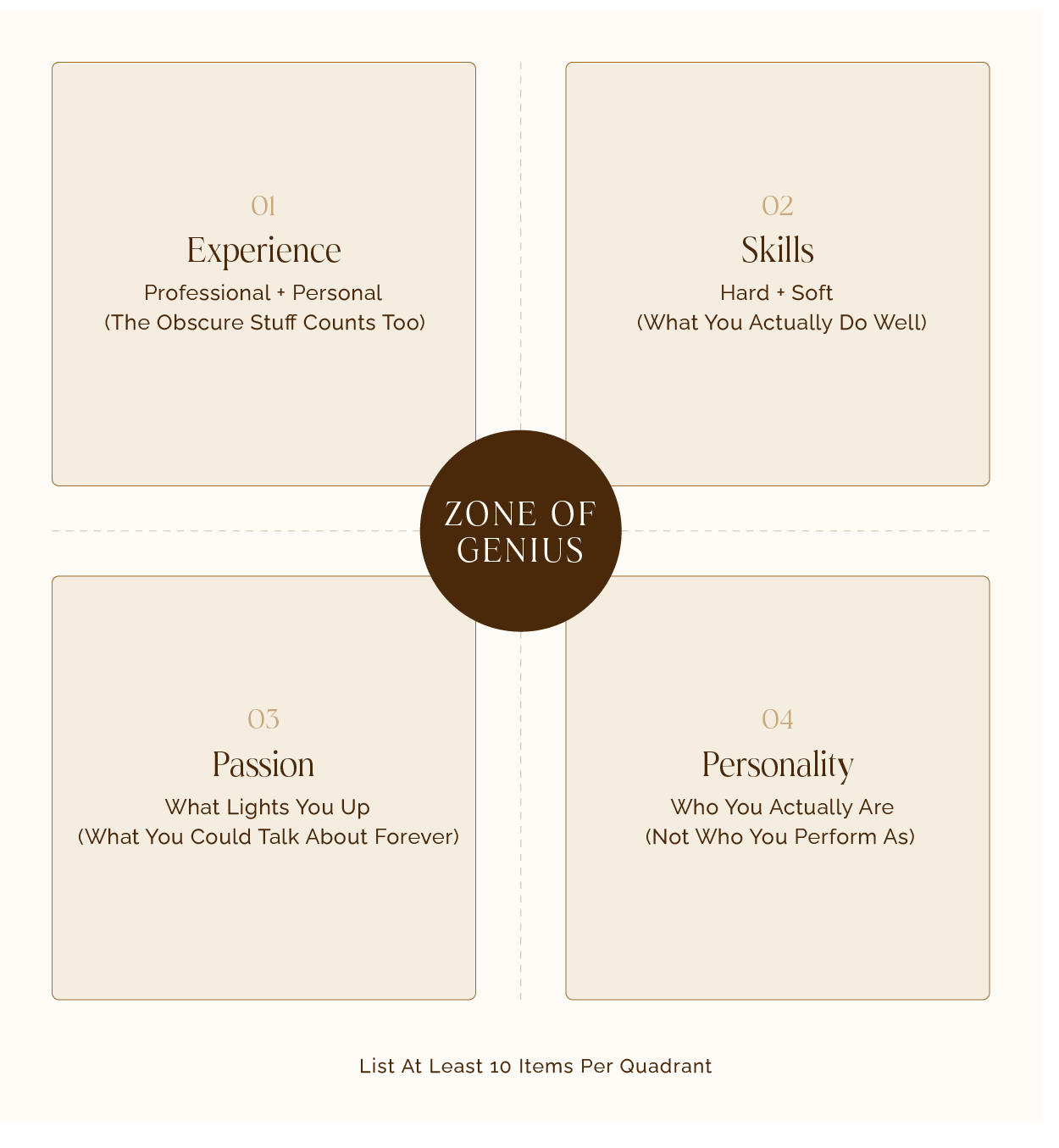
The Result
Your exact combination across all four quadrants is completely yours. No one else has your specific mix of experience, skills, passion, and personality.
Where those four areas intersect is your Zone of Genius, or the basis of your Unique Selling Point (USP).
But here's where most people stop. They do the exercise, feel good about it, and then let it sit in a notebook. The real value is in applying it.
How to Actually Use It
Brand Positioning
Your Zone of Genius gives you the language for why someone should choose you specifically. Not just "I'm a designer" but what kind of designer, for what kind of client, with what kind of lens. It's the difference between a positioning statement that sounds like everyone else's and one that actually sounds like you.
Content Voice
When you know what sits at the intersection of your experience, passion, and personality, you stop guessing what to write about. Your content naturally gravitates toward the topics you can speak to with authority and enthusiasm, which is exactly the kind of content that builds real trust with an audience.
Ideal Client Profile
Your Zone of Genius also tells you a lot about who you work best with. The clients who value what you specifically bring to the table, who are energized by your approach, who you do your best work for.
Your Bio
Most professional bios (i.e. LinkedIn profiles or website About pages) are a list of credentials and services. Yours should give someone a real sense of who they're getting when they hire you. The four quadrants give you the raw material to write something that actually sounds like a person, and generates opportunities for real connection.
Not Sure How to Apply It?
This exercise is a starting point. Knowing your Zone of Genius is one thing. Translating it into brand strategy, positioning, and messaging that actually connects with the right clients is where it transitions into a marketing strategy.
That's exactly what I do with clients inside a brand strategy session. If you've done the exercise and aren't sure what to do with it, or if you want to work through it with someone who can help you see the patterns you're too close to see yourself, let's talk. Schedule a free consultation call here.
Frequently Asked Questions
What is a Zone of Genius?
Your Zone of Genius is the intersection of your unique experience, skills, passions, and personality—the specific combination that only you have. It's different from simply being good at something. It's where what you're naturally excellent at meets what you genuinely love doing, and where your background and life experiences give you a perspective no one else can replicate. For service providers especially, it's often the real source of your competitive edge.
How do I find my unique selling point as a service provider?
Most service providers default to describing their USP in terms of what they do: their deliverables, their process, their tools. The problem is those things are easy to copy. A more durable approach is to build your USP around who you are: the combination of your background, your values, your perspective, and the kind of client you do your best work for. The four-quadrant exercise in this post is a practical starting point for getting there.
What should I include in a professional bio?
A strong professional bio goes beyond a list of credentials and services. It gives someone a real sense of who they're getting when they work with you: your background, what you care about, how you think, and why you do what you do. The most effective bios feel like a person wrote them, not a resume. Including a specific detail or two that reflects your personality or backstory makes you more memorable and builds connection before you've even had a conversation.
How do I stand out from competitors in a saturated industry?
In most saturated industries, the businesses that stand out aren't necessarily the ones doing something dramatically different. They're actually usually the ones who are clearest about who they are and who they're for. Specificity is what differentiates. That means being direct about your niche, your point of view, and the kind of client you serve best, rather than trying to appeal to everyone. Your background, your values, and the way you work are things no competitor can copy.
How does brand positioning relate to my Zone of Genius?
Your Zone of Genius is the raw material that brand positioning is built from. Positioning is how you communicate your distinct value to the right audience, and it's most compelling when it's grounded in something real and specific to you, not in a trend or a template. Once you know what sits at the intersection of your experience, skills, passion, and personality, you have the foundation for positioning that actually sounds like you and resonates with the clients you want most.
Aliya Mooney is a brand identity designer and strategist based in Boise, Idaho, and the founder of Hearthstone Creative. With a B.A. in Advertising and a background in in-house design, boutique agency work, and brand strategy, she works with established small business owners and values-driven founders to build brand identities that are strategic, intentional, and built to last. Learn more about Aliya here.